The guest asks if they can reach the room without stairs. The staff responds that the hotel is accessible, but they cannot explain the route, the conditions of the bathroom, or the available resources. The doubt persists, and the reservation depends on a promise that no one has verified.
Inclusive hospitality begins when the hotel provides concrete information, listens to the needs of each person, and organizes the operation to fulfill what was agreed upon. For reception and reservation managers, this involves service, infrastructure, and communication throughout the entire stay.
What is inclusive hospitality in practice?
Inclusive hospitality involves organizing services and environments to welcome people with different needs, respecting their autonomy, choices, and participation in the experience. In the hotel routine, it means identifying barriers and preparing responses that work from the accommodation search to the departure.
An adapted room may be necessary, but the service also depends on a comprehensible reservation, reliable information, and staff who know how to offer help. Accessibility does not end at the door of the accommodation.
This article primarily addresses the service to people with disabilities and reduced mobility. Other needs, such as dietary restrictions and communication preferences, also require individual listening. Avoid grouping different situations into a single generic "special service" procedure.
How to ask about needs without embarrassing the guest
Ask what conditions or resources the person needs to use the services and let them explain their preference. Speak directly to the guest, even when there is an accompanying person, and offer help before acting.
A possible approach during the reservation is: "To prepare for your arrival, is there any accessibility feature or service condition you would like to confirm? We can explain the characteristics of the accommodation and the route to it."
Then, confirm the request in operational terms. "Do you prefer to receive the instructions in writing?" generates a clearer action than simply recording "requires special attention." Do not assume that people with the same disability will use the same resources.
- Ask for permission before touching the person, wheelchair, cane, or any other support resource.
- Respect the response time and confirm understanding without infantilizing the guest.
- Do not turn the reception into an interview about the person's life or medical history.
- Offer communication alternatives and confirm which one works for that service.
What to confirm before accepting the reservation
Confirm the actual characteristics of the hotel, the availability of the requested resource, and who will be responsible for the preparation. The expression "accessible hotel" is insufficient for the guest to evaluate whether the establishment meets their needs.
Describe the route and the accommodation
Have an up-to-date inventory of access from disembarkation, routes to the reception and room, elevators, and common areas. Also record the verified characteristics of the bathroom, furniture, and communication resources. Measurements and specifications should be checked by qualified people, without relying on memory estimates.
Current photos and objective descriptions help the person evaluate the accommodation. If a certain restaurant can only be reached by stairs or an elevator is unavailable, inform this condition before the booking and refer the issue to management.
Differentiate received request from confirmed resource
A recorded request still needs to be verified. The reservations team should consult the responsible area, confirm availability, and record the response to the guest. When there is a pending issue, inform what is being investigated and when the person will receive a response.
Example: a guest requests text instructions and a room near the elevator. Reservations verifies the accommodation, reception confirms the communication channel, and housekeeping receives the necessary preparation. Each department responds for their part, without relying on informal messages.
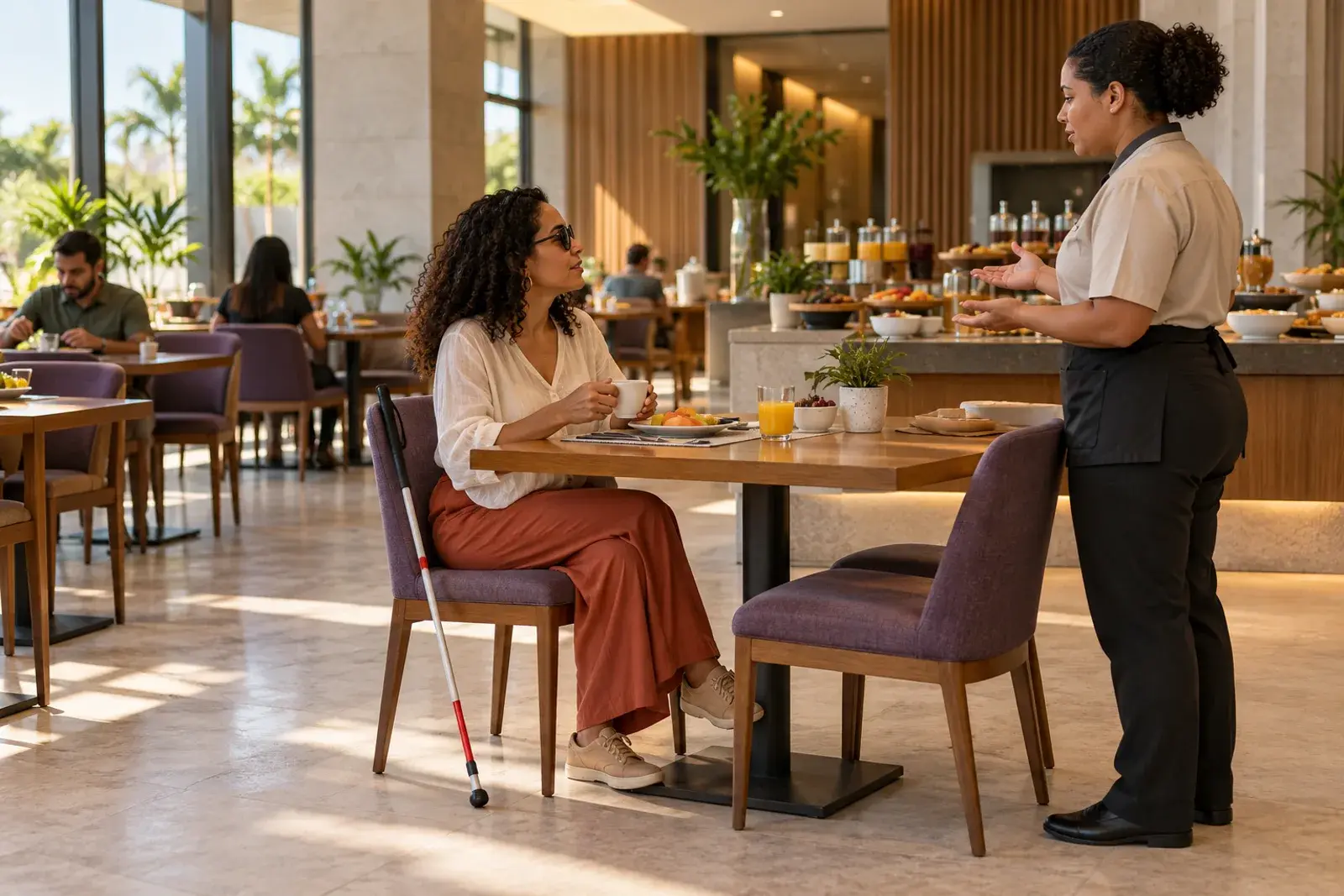
How to adapt the service during the stay
Adapt the communication and offer of help to the preference informed by the guest. The goal is to allow them to use the services with the maximum possible autonomy, without having to renegotiate the service at each shift.
Physical disability or reduced mobility
Keep circulation routes free of carts, luggage, and furniture. Confirm where the person prefers to be served and how they want to receive help. Do not push a wheelchair or improvise transfers between the chair, bed, or vehicle without permission and adequate preparation.
Visual disability
Identify yourself when starting the conversation and inform when you are moving away. Describe the environments and obstacles with clear references. If the person accepts accompaniment, ask how they prefer to be guided. Inform about changes in the room furniture and offer to read information when requested.
Hearing disability
Confirm the preferred channel: text, Libras, or another form of communication. Keep your face visible when it helps and do not assume that every deaf person can lip-read. Audio and phone calls need useful alternatives for those who cannot use them.
Cognitive and sensory needs
Use clear instructions, divide long procedures into steps, and allow time for information processing. If the guest reports sensitivity to noise or lighting, check concrete options for the environment and timing. Do not promise absolute silence or assume needs based on appearance.
How to maintain agreements between shifts
Record the requested resource, the confirmation given, the responsible person, and the preparation status. During the shift change, check pending issues that may affect the guest's arrival or stay.
The record should describe the necessary service discreetly. Health information is sensitive personal data under the General Data Protection Law. Management needs to define the purpose, legal basis, access, and adequate storage, avoiding exposure in informal groups or unnecessary notes.
Include these checks in the check-in and check-out checklist. Before releasing the accommodation, confirm that the agreed resources are present and that the route remains available.
What the law requires and what needs technical evaluation
Accessibility is a right. The Brazilian Inclusion Law addresses physical, communication, technological, and attitudinal barriers. The team's service is part of this experience, along with the conditions of the space.
For hotels and inns, the Decree No. 9,296/2018 regulates accessibility requirements and differentiates situations according to the construction or project dates. The text also covers common areas and on-demand resources.
Management should evaluate the property's classification, applicable technical standards, and local obligations with qualified support. A service checklist does not prove architectural compliance. Similarly, a completed construction does not exempt training, maintenance, and accurate reservation information.
How technology can support inclusive hospitality
Technology can help make preferences and agreements available to the team. For this, the hotel needs to maintain up-to-date information and have a clear process for confirming the requested resources.
The Digital Concierge from Desk Hotel allows organizing preferences by topics, including accessibility, and making them available in the service context. This record supports continuity between interactions; the verification of the structure and delivery remains with the operation.
If your team loses requests between the reservation and arrival, evaluate the Digital Concierge to organize this information. During the demonstration, present your real workflow and verify how to record, consult, and update agreements with the guest.
Where to start in your hotel
Start by reviewing a complete journey: asking for information, reserving, arriving, moving around, using services, and leaving. Invite people with different needs to evaluate the experience and transform identified barriers into actions with responsible parties and deadlines.
- Update the inventory of conditions and available resources.
- Review the responses used by reservations and reception.
- Define how to confirm requests and communicate limitations.
- Train the team with real situations, including failures and contingencies.
- Verify the delivery and use guest feedback to correct processes.
Inclusive hospitality is sustained when the information given before the reservation matches what the person finds at the hotel. Listening, preparation, and continuity make this commitment verifiable in the routine.
Frequently asked questions about inclusive hospitality
Does having an adapted room make the hotel inclusive?
The room is part of the experience. The guest also needs to obtain information, reach the accommodation, use areas and services, and communicate with the staff. Evaluate the complete journey and the adequacy of the resources to the informed need.
How to respond when you don't know if the resource is available?
Inform that you need to verify, consult the responsible person, and agree on a follow-up. Do not confirm accessibility or availability by assumption. Record the response so that another attendant can continue the conversation.
Is it correct to speak only to the companion?
Address the guest. The companion can participate according to the person's preference and the service situation. Their presence does not eliminate the guest's autonomy or authorize the staff to ignore them.
Can a small hotel start improving service now?
Yes. It can review information, clear routes, train the team, and organize confirmations immediately. These measures should accompany the evaluation and execution of the required physical and technical adjustments.
How to evaluate if the training worked?
Observe if the staff correctly describes the resources, asks for permission before helping, and refers doubts without improvising. Simulate a reservation and check if the request arrives confirmed at the reception and housekeeping.