The statement that every Brazilian property is required to pay exactly 18% commission to Booking.com must be handled with care. The platform states that the applicable percentage is specified in the accommodation contract and can be reviewed in the financial area.
The commission is not a fixed universal fee
According to the official partner center, the commission is a percentage of the reservation value, and the exact rate can be found in the contract and financial statements. This means that the manager should not use a number published by third parties as if it were a rule for everyone.
In addition to the commission, certain products, promotional programs, or payment services may have their own conditions. These should be reviewed in the property's current contract and extranet.
This article does not replace contractual, accounting, or legal analysis.
How to check the actual cost of the channel
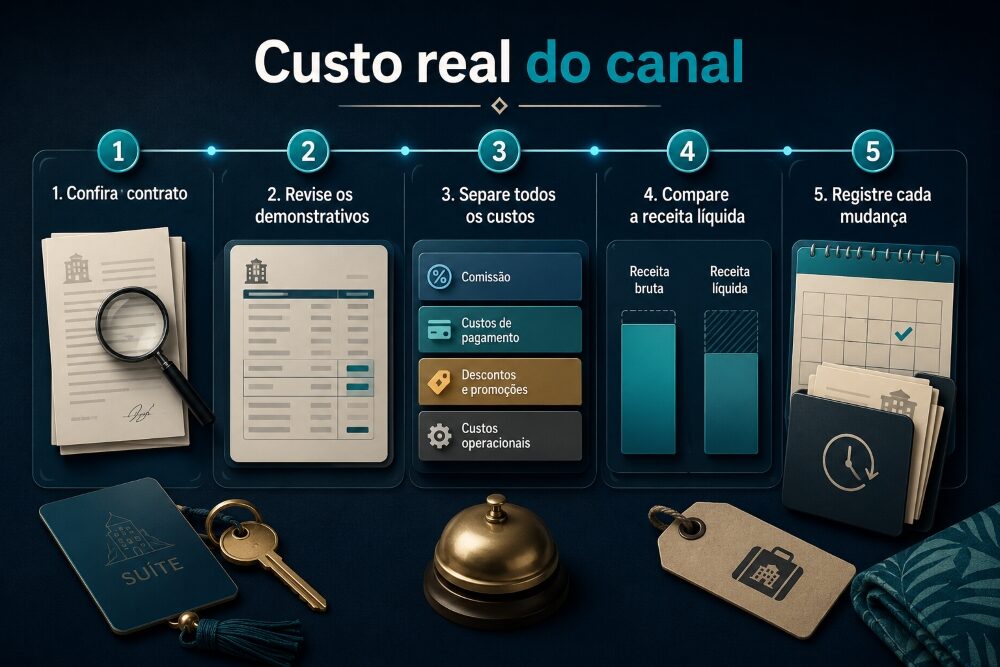
- access the property contract
- review the Financial area and reservation statements
- separate commission, payment costs, discounts, and participation in programs
- compare net revenue by channel
- record contractual changes and effective dates
The actual cost is not just the commission percentage. It includes discounts granted, cancellation rules, taxes, payment methods, and operational work.
Is OTA an enemy of the hotel?
No. OTAs can expand distribution and generate demand. The problem arises when the property does not know its margin, does not differentiate channels, and does not develop its own relationship.
The strategy should combine distribution with actions to react to the increase in intermediation costs and strengthen direct bookings.
The goal is not to abruptly abandon relevant channels, but to reduce vulnerability.

How to increase direct bookings
- clear and fast website
- functional booking engine
- quick WhatsApp service
- transparent policies
- exclusive benefits allowed by the contract
- follow-up on quotes
- post-stay relationship
The DeskHotel platform integrates service, CRM, budgeting, automation, and commercial journey, helping the hotel to convert its own demand without losing control of the channels.
Indicators to track
Compare gross and net revenue, acquisition cost, cancellations, lead time, length of stay, value per reservation, and recurrence. The participation of direct sales is only healthy when it does not depend on discounts that erode margins.
The journey tracking helps identify which campaigns and contacts actually generate bookings.
How to turn the agenda into an executable project
To make the 18% Booking commission more than just a good idea, the hotel needs to define a concrete problem, a priority audience, and an operational goal. The initiative can aim to increase demand in certain periods, improve conversion, extend length of stay, increase revenue per guest, or strengthen relationships. Trying to solve all these objectives simultaneously makes it difficult to interpret the results.
The first document of the project should record the hypothesis, offer, audience, channels, responsible parties, calendar, capacity, and success criteria. This discipline prevents marketing from promoting something that reservations or operations cannot deliver. It also facilitates subsequent review, as the team can compare what was planned with what actually happened.
Diagnosis before execution
The diagnosis should combine quantitative data and qualitative signals. Review reservation history, periods of higher and lower demand, questions received in service, reasons for budget loss, reviews, special requests, and conversations with guests. These elements help identify opportunities that do not appear only in financial reports.
It is also important to observe constraints. Physical capacity, staff schedules, contracts with partners, supplier availability, internal rules, accessibility, privacy, and security can limit the offer. Recognizing these limits at the beginning allows for creating a sustainable offer, rather than promising an experience that is difficult to repeat.
Mapping the guest journey
Map the journey from the first contact to the post-stay. At each stage, define the information the guest needs, the actions the team expects, and potential objections. The sales page, ads, service, and reception should use the same description of the offer. Discrepancies between channels reduce trust and increase rework.
The mapping should also anticipate exceptions: unavailability, date changes, rain, partner cancellations, delays, dietary restrictions, accessibility needs, or payment failures. A professional experience is not one where nothing goes wrong, but one where the hotel is prepared to respond when something goes off-plan.
Pilot project and learning
Before scaling, conduct a pilot with a defined period, capacity, and audience. The pilot should be large enough to generate learning, but small enough to allow for corrections. Record questions, failures, service time, manual steps, and guest reactions. The team executing the project should participate in the evaluation, not just the leadership.
At the end, classify the learnings into four groups: what should be maintained, what needs to be corrected, what should be eliminated, and what deserves a new test. This analysis is more useful than deciding based solely on occupancy or reach. A campaign can sell and still create operational issues that compromise reviews and return.
Indicators to help evaluate the 18% Booking commission
The indicators should follow the logic of the initiative. For acquisition, observe the origin of opportunities, cost, response rate, and conversion. For revenue, analyze net value, length of stay, additional consumption, and margin. For experience, track questions, complaints, reviews, and intent to return. For operations, measure time, capacity, failures, and volume of manual tasks.
Avoid evaluating an action solely by occupancy. A hotel can increase occupancy through excessive discounts, attract an incompatible audience, or generate costs that offset additional revenue. The analysis must consider the quality of demand, margin, and the possibility of repetition.
The role of service and CRM
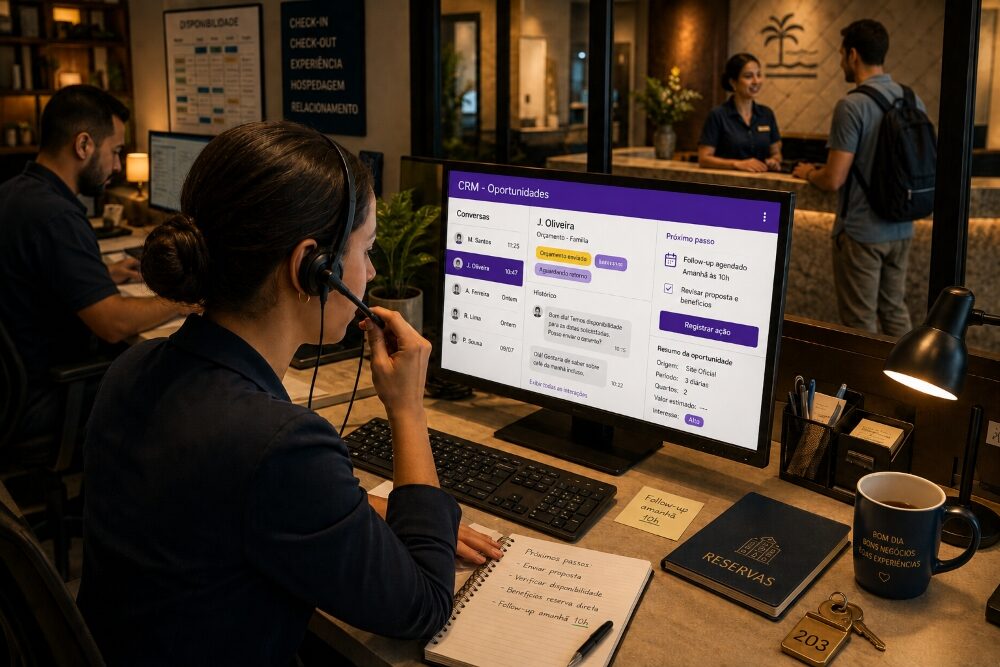
Service is a strategic source of intelligence. Questions, objections, and reasons for abandonment should be recorded in a structured manner. When this information is scattered across cell phones and notes, management loses the ability to learn from demand.
CRM allows you to create segments, track opportunities, and identify which messages work for each audience. Automation can handle confirmations, reminders, and follow-ups, but must respect context, consent, and frequency. The goal is to make communication more relevant, not just to increase the number of messages.
How to optimize content for search and AI responses
The page should answer the main questions clearly before delving into details. Direct definitions, descriptive subheadings, examples, lists, and frequently asked questions help search engines and AI systems identify context and retrieve useful snippets. This does not replace editorial quality; it only makes the information more organized.
It is also important to connect the article to relevant pages on the site. Internal links should deepen understanding and guide the reader to a coherent next step, such as service, CRM, automations, booking engine, or complementary materials. Inserting links just to increase quantity can confuse users and dilute the content architecture.
Specific data and statements require a traceable source. Always record the date of the query and prefer official documents, responsible companies, regulatory bodies, or original research. When the source is not accessible, it is better to explain the trend without reproducing an isolated percentage.
Continuous updates
The article should be reviewed when there are changes in rules, contracts, tools, platform policies, or market behavior. Updating does not just mean changing the date: it is necessary to check links, remove outdated guidance, incorporate new questions from service, and verify if the presented solution remains compatible with the hotel's operation.
Common mistakes that weaken the strategy
- copying an initiative from another business without adapting to the hotel's positioning and structure;
- using discounts as the only value proposition;
- promoting before aligning reservations, reception, housekeeping, and partners;
- not informing conditions, limits, dates, and items subject to availability;
- collecting data without purpose and without adequate protection;
- measuring only reach, clicks, or gross occupancy;
- automating messages without providing human service;
- ending the campaign without documenting learnings.
Checklist for publication and operation
- Confirm all information, prices, dates, capacities, and policies.
- Review the page on mobile and test forms, links, and the booking engine.
- Prepare responses to the main questions and objections.
- Define responsible parties for service, partners, and problem resolution.
- Configure source, tags, and follow-up steps in the CRM.
- Test automations with internal contacts before sending to the public.
- Monitor the first services and correct ambiguous messages.
- Conduct a final review with sales, operation, and satisfaction data.
This process does not eliminate uncertainty, but it reduces improvisation. The combination of strategy, execution, data, and service makes the 18% Booking.com commission a more consistent and defensible initiative for management.
Frequently Asked Questions
Is the Booking.com commission always 18%?
No. Booking.com itself advises that the exact rate be consulted in the accommodation contract and financial area.
Where do I see the commission for each reservation?
In the reservation statements and the Financial area of the extranet, according to the platform's official guidelines.
Should the hotel leave OTAs?
Not necessarily. The decision should consider demand, margin, positioning, and the ability to generate direct bookings.
How to reduce dependence?
Strengthen the website, booking engine, service, CRM, relationships, reputation, and own campaigns.
Conclusion
Is the 18% Booking.com commission mandatory? Understanding the charge and protecting the hotel's margin is an agenda that requires planning, data analysis, and consistent execution. Hotels that connect value proposition, service, relationships, and technology can turn good ideas into marketable experiences for more months of the year.