A reception can abandon paper forms and still be surrounded by loose messages, unaccompanied proposals, and information that doesn't reach the next shift. The mandatory Digital FNRH solves an important step in guest registration, but it also raises a larger issue: digitalization is not just about changing the medium; it's about making data flow through the operation without relying on repeated typing or team memory.
Since April 20, 2026, accommodation providers must use the Digital National Guest Registration Form. This change was established by the MTur Ordinance No. 41/2025, whose effective date was adjusted by the MTur Ordinance No. 4/2026. For hotel and inn managers, the most relevant point goes beyond compliance: the new rule sets a new level of fluidity for the guest journey.
What is the Digital FNRH and what has changed?
The Digital FNRH is the mandatory electronic registration of guests in Brazilian accommodation facilities. It completely replaces the physical form, except in the contingency situations provided for in the regulation, and centralizes the receipt, validation, organization, and storage of data on the platform of the Ministry of Tourism, developed with Serpro.
In practice, the guest can advance the filling out process through a link or QR Code provided by the establishment. Upon arrival, the staff verifies and confirms the data. Pre-check-in is optional; the formal check-in continues to take place at the accommodation, with the guest's presence. For the step-by-step adaptation, also consult the practical guide to FNRH in hospitality.
Authentication of the traveler through the gov.br account is not the only access method. The Ordinance provides alternatives with or without gov.br credentials, including links, QR Codes, or devices provided by the hotel. The establishment accesses the platform through a gov.br account linked to the responsible party and must maintain regular registration in Cadastur. The official FAQ of the Ministry of Tourism gathers updated operational guidelines.
The role of PMS in the new routine
The regulation provides two main paths: using the module provided by the government or integrating a PMS with the platform via API. Integration allows for automated and secure data exchange for reservations and accommodation. This does not mean that every hotel system is already integrated; each establishment must confirm compatibility with its provider and follow the official technical documentation.
This design is important because it avoids turning a digital obligation into a new manual task. If the reception has to copy information between systems, the paper disappears, but the rework remains.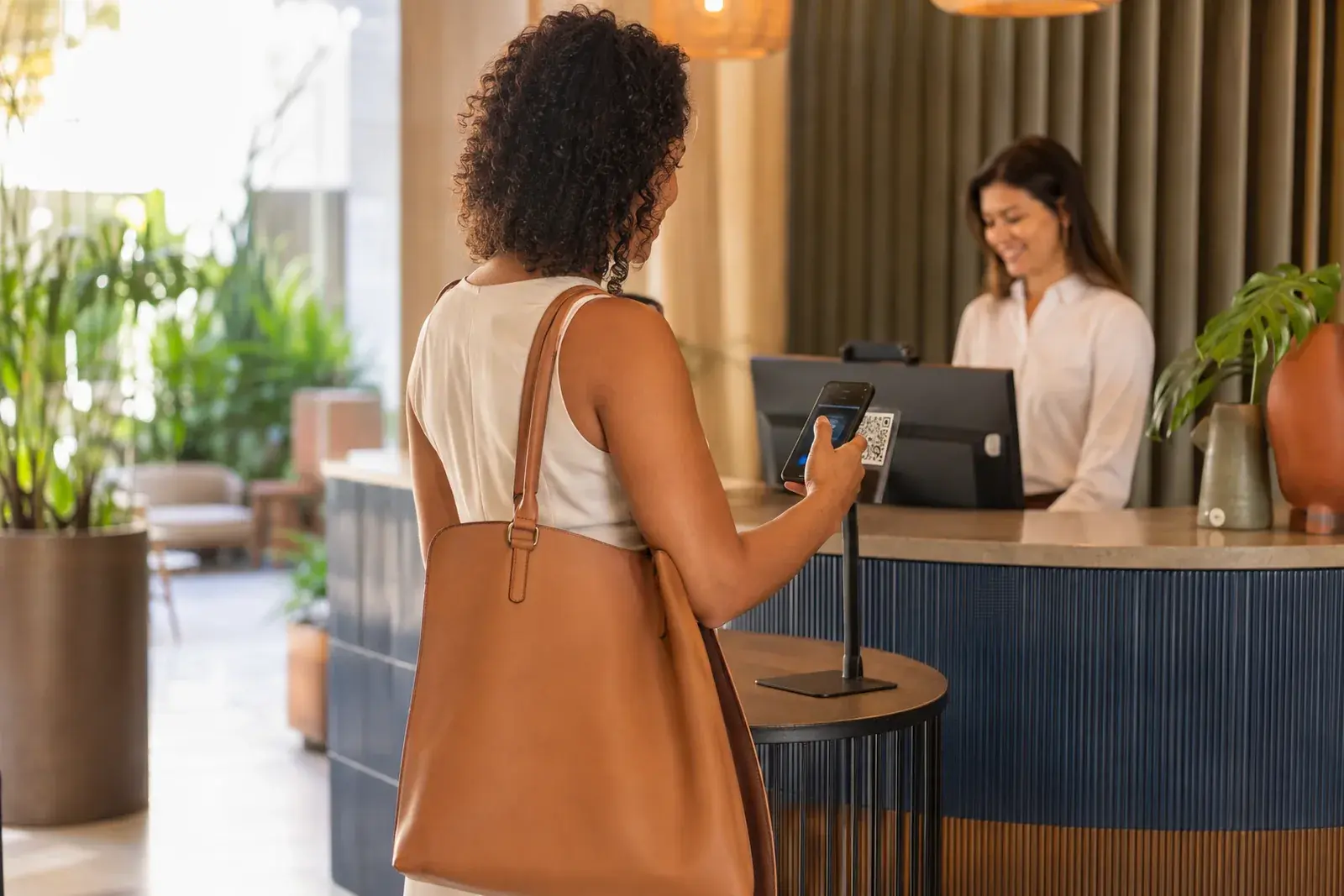
Why does digitalization reduce friction at check-in?
Pre-check-in shifts data collection to before arrival and keeps the counter focused on verification, confirmation, and welcoming. The operational gain comes not just from a faster screen, but from the change in when the task is performed.
During a peak in arrivals, each interruption weighs heavily: locating a reservation, deciphering a handwritten field, requesting a document again, or correcting incomplete data increases the queue and pressures the team. When information arrives in advance and in a structured manner, the reception can identify pending tasks before the guest is waiting.
To take advantage of this benefit, the hotel needs to design the process, not just provide the QR Code. It's worth defining:
- when and through which channel the pre-check-in link will be sent;
- who follows up on incomplete forms before arrival;
- how the reception identifies reservations ready for verification;
- what procedure to use when the platform is unavailable;
- how to guide guests who prefer not to use the gov.br account;
- who manages users and permissions for the establishment.
Pre-arrival messages can support this flow. The page on automations for the guest journey of DeskHotel confirms the possibility of sending information and links before check-in, reducing the team's reliance on manual reminders.
Less paper does not, by itself, mean an integrated operation
The Digital FNRH modernizes the legal registration of the guest, but it does not automatically organize all the steps that come before and after it. An operation remains fragmented when the conversation starts on WhatsApp, the proposal is built elsewhere, the payment is verified by message, the reservation enters the PMS, and the special request is noted in an internal group.
The warning sign is simple: if the team needs to ask "where is this information?", the process still depends on people manually connecting systems.
This fragmentation generates known problems in hospitality:
- the guest repeats data and preferences at different stages;
- the attendant loses context when the conversation changes channels or shifts;
- a sent proposal goes without follow-up;
- pre-arrival requests reach the operation too late;
- management cannot securely reconstruct the commercial journey.
Mature digitalization connects decisions and responsibilities. Data collected at one stage should be available, with the appropriate access, to those executing the next. This requires technical integration where possible and, always, clear rules of process, permission, and data handling.
Integration between systems becomes an operational criterion
The MTur Ordinance No. 41/2025 itself defines PMS, API, integration key, and error log. In other words, integration does not appear as a peripheral detail: it is part of the operational architecture foreseen for the Digital FNRH.
Before integrating any system, the hotel should evaluate four points:
- Data source: in which system does each piece of information originate and where should it be updated?
- Responsibility: who checks failures, duplicates, and pending tasks?
- Permissions: which profiles really need access to personal data?
- Contingency: how does the operation continue and regularize records when a service is unavailable?
It is also necessary to avoid a common interpretation: integration does not eliminate supervision. Automation reduces repetitive tasks, but the team remains responsible for verifying check-ins, handling exceptions, and protecting access credentials. The goal is to remove friction from the path, not to remove responsibility.
The guest perceives a journey, not the hotel's systems
For the traveler, reservation, pre-arrival, check-in, stay, and post-checkout form a single experience. They do not know—nor should they need to know—how many internal tools the hotel uses. The perception of quality arises from continuity: consistent information, context-aware responses, and the absence of repeated requests.
Therefore, a digital check-in can increase expectations for the rest of the journey. If the entry is quick, but a question sent before the trip goes unanswered for hours, the experience remains uneven. If the data was provided in advance, but the reception asks everything again, the promise of convenience is lost.
The article on technology in hotel service delves into how centralization, automation, and human service can work together. The principle is the same: useful technology eliminates steps that do not add value and preserves the team's time for welcoming, negotiating, and resolving non-standard situations.
Which processes should the hotel modernize after check-in?
The next process to modernize is the one that combines high volume, manual repetition, and direct impact on revenue or experience. For many hotels, this puts service, proposals, and follow-ups at the top of the list.
1. Service in dispersed channels
When WhatsApp, Instagram, email, and chat are treated separately, the history breaks and the distribution of demand depends on parallel controls. Centralizing channels helps preserve context and define responsible parties, deadlines, and priorities.
2. Proposals without traceability
Sending a quote is just one step in the sale. The team also needs to know what phase the negotiation is in, what the next action is, and why an opportunity was lost. The sales CRM for hospitality from DeskHotel brings together funnels, tasks, interaction history, and loss reasons, features confirmed on the official module page.
3. Follow-ups dependent on memory
A proposal without a return should not disappear in the volume of messages. Tasks and automations can trigger reminders or re-engage the contact according to rules defined by the hotel. The team steps in when there is context for negotiation, exception, or human decision.
4. Improvised pre-arrival communication
Guidelines on documents, times, access, and pre-check-in need to arrive in advance and consistently. Standardizing content and automating the timing of sending reduces forgetfulness without preventing the team from personalizing the conversation when necessary.
How to create a digitalization plan that does not generate more fragmentation?
Start with the real journey, not the list of tools. Map the path of a reservation from the first message to post-checkout, marking each system switch, manual copy, wait, recurring doubt, and loss of context.
Then, prioritize initiatives based on three criteria: impact on the guest, time consumed by the team, and risk to revenue or compliance. For each change, define a responsible party, an exception rule, and a simple operational indicator—such as the volume of pending forms before arrival or proposals without a next task.
Finally, test the flow end-to-end. An isolated automation may work technically and still deliver a poor experience if it triggers at the wrong time, repeats information, or ignores an update made in another system. The review should include reception, reservations, sales, and management, as the journey spans all these areas.
The Digital FNRH is a starting point for a connected operation
The mandatory Digital FNRH makes visible a change that has already reached the routine of accommodation providers: processes based on paper, duplicate typing, and isolated controls have difficulty keeping up with a journey that begins long before the counter.
The hotel that treats the change only as a requirement will complete a step. The hotel that uses it to review how data flows through service, sales, reservations, and reception can build a more coherent operation. It's not about digitalizing everything at once, but about methodically choosing the next bottlenecks and connecting each improvement to the experience that the guest actually perceives.
Your hotel has already digitalized guest registration. Now it's time to organize service, proposals, and follow-ups as well. Discover the integrated platform from DeskHotel and evaluate how to connect the commercial journey to the operation.
Frequently asked questions about the Digital FNRH
Is the Digital FNRH mandatory for hotels and inns?
Yes. The Digital FNRH is mandatory for accommodation providers covered by the legislation and has been in effect since April 20, 2026. The establishment must also maintain a regular status in Cadastur to access the platform.
Is the guest required to have a gov.br account?
No. The MTur Ordinance No. 41/2025 allows the guest to access the Digital FNRH with or without gov.br credentials, including through QR Code, shared link, or device provided by the establishment. The gov.br account can speed up validation, but it is not the only way.
Does pre-check-in replace confirmation at the reception?
No. Pre-check-in advances the filling out process, but check-in must be confirmed at the establishment, in the presence of the guest, with verification of the registered data.
Does the hotel need to hire a PMS to use the Digital FNRH?
No. The accommodation provider can use the module of the platform itself. Integration with PMS via API is an alternative to automate data exchange, provided that the system used is compatible and follows the official documentation.
Can the paper form still be required?
As a rule, no. The Digital FNRH completely replaces the physical form and has the same legal effects. The regulation preserves specific contingency procedures for situations of unavailability.
Does digitalizing check-in integrate the entire hotel operation?
No. The Digital FNRH organizes the mandatory guest registration, but service, proposals, payments, follow-ups, and pre-arrival communication can remain fragmented. Integrating the journey requires mapping processes and connecting relevant tools.